
Memoir, Nonfiction

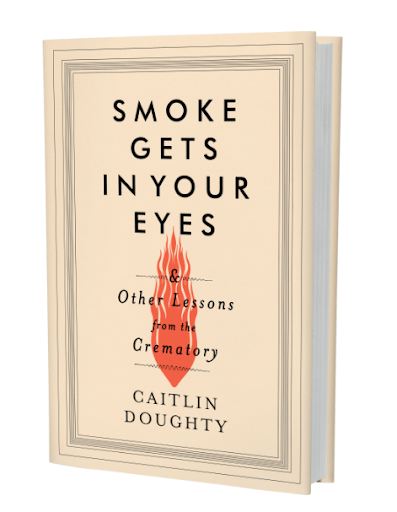
Smoke Gets In Your Eyes & Other Lessons from the Crematory, by Caitlin Doughty

unnamed

Last year, after my mother-in-law passed away, I happened upon a YouTube video entitled “What happens when you’re cremated?” I wasn’t trying to be morbid, I promise. I just like learning new things and, hey, here was a new thing that was exactly what we were going through.

Aside from the information, the video’s hostess, Caitlin Doughty, was great. I started looking around her channel, called Ask a Mortician, and watched more of her videos. You know what I learned? A lot! (For instance, did you know that embalming is not required by law before burial? Did you know there is a “green” version of cremation that uses water instead of fire?)

But what I mostly learned, was that despite having planned 3 funerals/wakes/Celebrations of Lives in the last 12 years, I knew very little about what actually happens to a corpse from the time it arrives at the funeral home to the time it is interred or buried. The industry is designed that way–to sell you the embalming/cremation/burial packages and to shield you from your vast multitude of options. Many of these options are less expensive, more eco-friendly, simpler, and give the grieving family a way to intimately participate. That shielding is not doing us any favors.

So, we the living, advocate for the deceased. But who advocates for the living? Enter Caitlin Doughty, who has made it her mission to pull back the curtain of the funeral industry and give us a look inside. As. It. Should. Be.

In her first book, Smoke Gets In Your Eyes & Other Lessons from the Crematory, we see the author’s foray into the funeral industry as a lowly crematory operator in San Francisco. It’s far from glamorous, but she learns a lot in those few months and we learn right along with her. After that, it’s mortuary school and pretty much being on call 24/7 while driving the “body van” up and down I-5, boomeranging between San Diego and Santa Barbara.

As you probably guessed, this is not a subject for the squeamish, but it’s important. Death is something none of us will avoid. It discriminates against no one. And right now, during the COVID-19 pandemic, most of us are probably thinking about death more than usual. So learn about it. Make a plan so that your family isn’t left guessing. Learn from the good and bad decisions of others. Reading this book is a very entertaining and informative way to start. You’ll be amazed at how much you don’t know, but you’ll also revel in Doughty’s writing style, which is witty, a bit sardonic, but respectful of her vocation.

Caitlin Doughty has written two more books, both of which I plan to read and review in the future. She also owns her own funeral home in Los Angeles, runs a website called The Order of the Good Death, and, of course, her YouTube channel, Ask a Mortician.

Here’s a little intro:

Ask a Mortician YouTube Channel

The Order of the Good Death website (designed to provide education and transparency about the funeral process.)

9/10 Stars

Christian Fiction, Fiction, Historical Fiction, Series & Collections

Muddy: Where Faith and Polygamy Collide, River: Where Faith and Consecration Converge, by Dean Hughes

Muddy_Where_Faith_and_Polygamy_Collide

I’m going to combine the first two novels in Dean Hughes’ newest series:

MUDDY: Where Faith and Polygamy Collide

If you’ve ever wondered what it was like to be a polygamist family in the early days of the Utah pioneers, look no further. Muddy, and the books following it in the series, will give you a fly-on-the-wall view.

Morgan Davis, a faithful young man in his 20’s from Farmington, Utah, has been asked to marry and settle in Southern Utah. Over time, despite his great hesitancy to participate in polygamy, he is asked to marry again.

But there is more to the story–much, much more. There is the setting up in a new place, the adjustment to being a husband and father, and the challenges that accompany hard living while farming and having to provide everything for your family in a place with no resources or commerce.

When Morgan is asked to marry his second wife, Ruth–a quiet young widow–he and his first wife, Angeline, must navigate this new dynamic in their family. What are the logistics when there are two wives? We are privy to all of this, and it’s fascinating.

52329908._UY1000_SS1000_

RIVER: Where Faith and Consecration Converge

Just when Morgan thinks his life is on track, he is thrown more curve balls. River begins with a grasshopper plague swarming into the community. Dean Hughes describes it in such detail, you feel yourself swatting the insects away.

But the biggest new challenge, aside from the grasshoppers, is that Morgan Davis is asked to move with his family to a new settlement and begin living the United Order’s Law of Consecration. If we thought the logistics of plural marriage were challenging, living this law is even more difficult. Many hands might make light work, but they also bring different viewpoints, personalities, and interpretations of rules.

Meanwhile, Washington DC is starting to pursue polygamist families. Morgan, his wives, and children must prepare and decide what to do should he be hauled away by the deputies.

River is a very “meaty” book, with a lot more intensity and personality clashes than its predecessor, Muddy. A terrific second book in the series.

My Observations

Dean Hughes is a very gifted writer. He has a way of showing us the thoughts and feelings of different characters that is both realistic and detailed. He explores an impressive array of human emotion. During the multiple talks to set up the Law of Consecration in the community, Hughes touches on nearly every kind of concern that people would have when asked to live such a lifestyle. It takes an enormous amount of faith and selflessness, things that are difficult for even the best of people.

But I think the thing that impresses me most about Hughes’ writing style is the way he writes women. He seems to know how women tick, their worries and fears, their jealousies and concerns. I am constantly amazed at how well the female characters’ innermost thoughts are described.

This is historical fiction at its best, with realistic fictional characters living and interacting with actual figures from history. I find myself often in moments of self-reflection wondering how I would react to the hardships these people faced and the things that were asked of them by their church leaders.

9.5/10 Stars