Fiction, Young Adult

Last Summer Boys, by Bill Rivers

“Don’t you ever do anything to make somebody feel like their life is no account to you, hear?”…”Yes ma’am…” “It’s the worst thing you can do to a person.”…”Worse than killing them?”…”It’s a kind of killing,” Ma says. “A killing of the soul. Don’t you do it.”

Summer 1968. The Vietnam War is raging. Sons are going off to fight and not coming home. The thought of losing his big brother, Pete, is more than 13 year old Jack Elliot can bear. His plan? Make Pete famous before he turns eighteen at the end of summer. Famous boys don’t get drafted, right? And, if they do, they get cushy assignments until the fighting is over.

Jack is our narrator and he, along with Pete, 16 year old Will, and their visiting cousin, Frankie, turn their weeks together into a summer to remember. They test the limits of each other, the elements, and their ever-patient parents. They react to the chaos of the late Sixties, conforming or rebelling as you would expect from growing teenage boys. Even in their rural Pennsylvania town, the reality of things escalating is inescapable.

Through it all, plus run ins with bullies, neighbors, and cute girls, the four boys stick together, supporting each other through thick and thin while experiencing their own growth.

This is a fantastic novel, appropriate for everyone, with special significance to those affected by that time in history. Every character is deep and multi-faceted, with his own inner turmoil and moral compass. I highly recommend it and look forward to others by this author. (Available free with a Kindle Unlimited subscription.)

9.5/10 Stars

Children, Fantasy, Young Adult

The Ogress and the Orphans, by Kelly Barnhill

I know a book is excellent if its effects are still lingering days after I’ve finishing it. Few have accomplished this as much as The Ogress and the Orphans, by Kelly Barnhill. Is it for kids? Yes. Is it for young adults? Yes. Is it for grownups? Yes. Yes, yes, and yes. It’s for everyone. If I could buy up a bunch of copies and pass them out on a street corner without looking like a weirdo, I would.

There is the Ogress. She has no name. She has no family. She has no friends. She cannot read. She has a great desire to belong. She has magical talents that benefit others and, even in her loneliness, she is compassionate and generous.

There are the Orphans. They have names that follow the letters of the alphabet. They are cared for by the Matron and her husband, Myron. They read and research. They closely observe. They are each other’s family.

There is the town, Stone-in-the-Glen. Once a lovely place where neighbor helped neighbor, it is now rundown and full of unhappy, suspicious people. Legend says it all began when a dragon burned down the library. Now the only bright spot is the colorful Mayor. He loves all and all love him.

What makes this book so special? What makes it a treasure for readers of any age? It is so layered with important messages that everyone will glean something from it. The writing is magnificent. The characters will remind you of someone you know.

Read it. Share it. Learn from it. Remember it. It’s marvelous!

10/10 Stars

Romance, Young Adult

Three Heartfelt YA Novels

Recently I joined a fun online book group! We do Bingo boards, read-a-thons, and scavenger hunts, all of which have pushed me out of my comfort zone. Young Adult novels are very popular with this bunch, so I’ve read a few lately.

These three are my current favorites.

PLACES WE’VE NEVER BEEN, by Kasie West brought back some childhood memories. Two families go on a road trip together after one family moved away a few years before. The kids all have their favorites, but Norah’s and Skyler’s friendship has been reduced to liking each other’s Instagram posts. (Boy, do I feel old.) Norah is excited to see her friend again, but Skyler is distant and apathetic. Only by communication, forgiveness, and working through misunderstands will they repair the friendship. 9/10 Stars

TELL ME THREE THINGS, by Julie Buxbaum is a novel I was introduced to by our book group admin, who is a connoisseur of the YA genre. I LOVED IT. It’s like a teenage You’ve Got Mail (oops, dated myself again) and I was completely swept away. Jessie is mourning her mother’s loss and adjusting to a new school, new state, and new step-family. An online friend introduces him (or herself) as “Somebody/Nobody,” offering to help Jessie navigate high school, with its angst and cliques. Is it a joke? Or can this person be trusted? Over time, Jessie and “SN” confide in each other more and three different characters become candidates for the anonymous friend. The story is extremely sweet with a great ending. 9.5/10 Stars

WHAT I DIDN’T SAY, by Keary Taylor is my favorite of the three, only slightly edging ahead Tell Me Three Things. After a horrific drunk driving accident, Jake Hayes’ vocal cords are irreparably damaged when a post goes through his throat. One of seven kids in a boisterous, loving family, Jake will never talk again. Back at school, his longtime crush, super student Samantha Shay, becomes his tutor and close friend. Sam has secrets of her own. She’s getting thinner, sadder, and more detached. Together, Jake and Sam help each other, filling in the gaps in the other’s life and creating an unbreakable bond. Did I mention how much I loved this book?? And Jake’s family is awesome. 9.5/10 Stars

Fiction, Young Adult

A Quiet Kind of Thunder, by Sara Barnard

It’s always unexpected to find a book that speaks to you on a very personal level, but that is how I felt while reading A Quiet Kind of Thunder, by Sara Barnard. And, although it is a Young Adult novel that explores much of the angst all teens experience, it is so much more.

Our narrator is Steffi Brons, age sixteen. Steffi has crippling social anxiety. Crippling to the point that she is a selective mute, which makes her an interesting choice as narrator. Steffi taught me a lot. For one thing, the word “selective” does not mean that the person selects when they do or don’t talk. On the contrary, she wants to talk, especially when the alternative is getting stared at and bullied. It’s her anxiety level that chooses when she speaks. Anxiety is not rational, but she’s usually OK with her family, best friend, and boss. But parties? Shops? And, Heaven forbid, school? Big N-O.

Steffi is fortunate to have some anchors in her life. Her dad is patient and kind. Her friend, Tem (September,) is her advocate and cheerleader. Her mom? Not so much. Speaking as someone who has anxiety (to a much lesser degree but still very real,) little victories are to be celebrated and pushing usually has the opposite effect. “C’mon, Steffi…just try harder…” Well meaning but definitely not helpful.

As a child, Steffi’s uncle suggested that she learn BSL (British Sign Language) as a way to compensate for those times when communication was necessary but speech was not forthcoming. This skill makes her the prime candidate to be paired up with Rhys Gold, a new student who is deaf. Rhys is friendly, outgoing, and fairly adorable.

Yes, you can guess correctly that Steffi and Rhys go from classmates to friends to more. But that does not make the story predictable. At the heart of everything is communication, its variations, its inclusiveness, and its means as a tool to validate people. Whether it’s speaking, signing, gesturing, writing, etc.–it connects us with others. And, in some cases, it isolates. The story is also about Steffi’s growth, her wavering confidence, the kind of support she gets, and its importance.

I loved this book. It has the language and sexual experimentation that you would expect from a contemporary Young Adult novel about teenagers and first love, but the explanation of anxiety is SO on point. I rooted for these two and appreciated the fact that there was no ridiculous drama, just the normal ups/downs/questions that we have at that age. A wonderful discovery that touched my heart.

9/10 Stars

Biography, Black History, History, Nonfiction, Young Adult

The Life of Frederick Douglass, by David F. Walker

For the second time in two weeks I am completely bowled over by a book I discovered accidentally. I have so many thoughts right now…

With so much racial unrest happening I feel that one of the things we need to do is get at the core–its history and its reasons. Obviously, there is no one alive right now who can tell us what it was like to be a slave in the United States during the 1800’s, but when you read Frederick Douglass’s own words, you get pretty close.

I learned so much about this important historical figure who I thought I already knew. When I read about Harriet Tubman and the early suffragettes, Susan B. Anthony and Elizabeth Cady Stanton, Frederick Douglass is always mentioned. But until now, I did not know his personal history.

In this powerful book you learn about his entire life, from birth to death: his boyhood, his mother, his escape, his wife and children, and, of course, his determined quest to help abolish slavery.

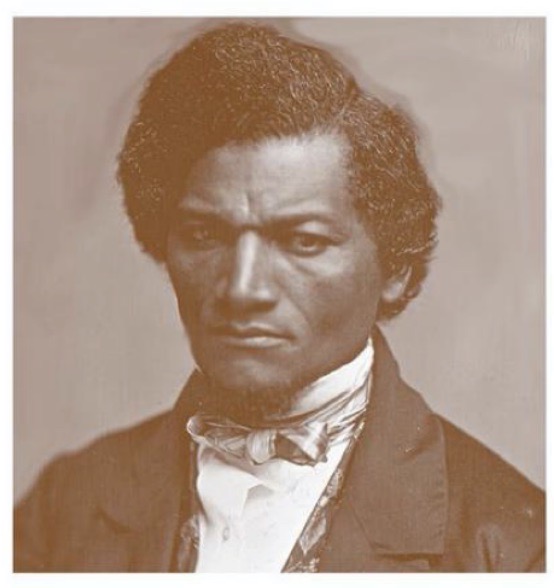
Although it was not the custom at the time, Frederick Douglass purposefully looked into the camera when his picture was taken. He felt it showed his humanity and resolve.

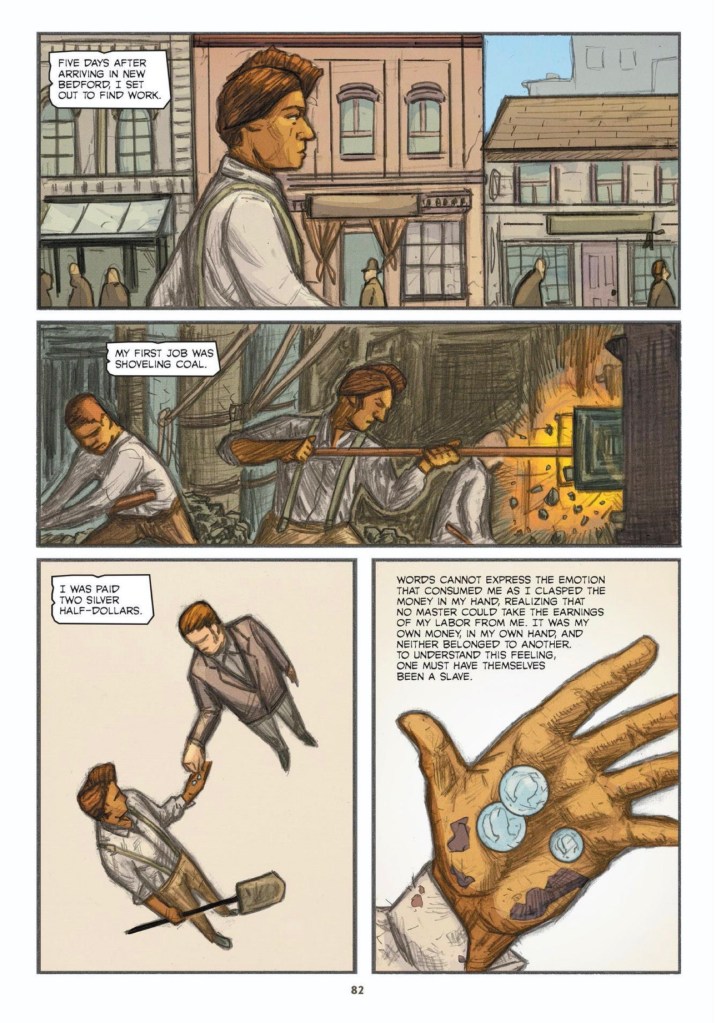
This particular screen shot is one of many quotes by Douglass that made me realize the amount of guilt he often felt. Throughout his life he dealt with much internal conflict, always wondering if he was doing enough to help the slaves and always putting pressure on himself to be an example of dignity. He felt great responsibility to show others that a (former) slave is a person with intelligence and emotion, not just a piece of property to be bought, sold, and abused.

I highly, highly recommend this graphic novel to adults and young people. (Probably a mature 10 years old and older.) Although it chronicles an era of the past, its themes are still relevant. Mostly, that while many agree that change needs to happen, they differ on how to achieve that change. Until that question is resolved, how can things be different?

10/10 Stars

This book is available on Amazon.com, or perhaps your local digital library, which is where I found it. Just look at these amazing drawings by David F. Walker:

Black History, Children, History, Nonfiction, Poetry, Young Adult

A Wreath for Emmett Till, by Marilyn Nelson

41xN5LACnwL._SX351_BO1,204,203,200_

This country we love has a Janus face: one mouth speaks with a forked tongue, the other reads the Constitution.

Let us first define what a Janus face is: cb922372af7ff4692a4ccfe77b79d2bbAmong other things, Janus was the Roman god of duality. And while America represents the Land of the Free for some, it is still a land of hypocrisy, fear, and double standards for many. The last couple of weeks have been a painful, shameful reminder of this.
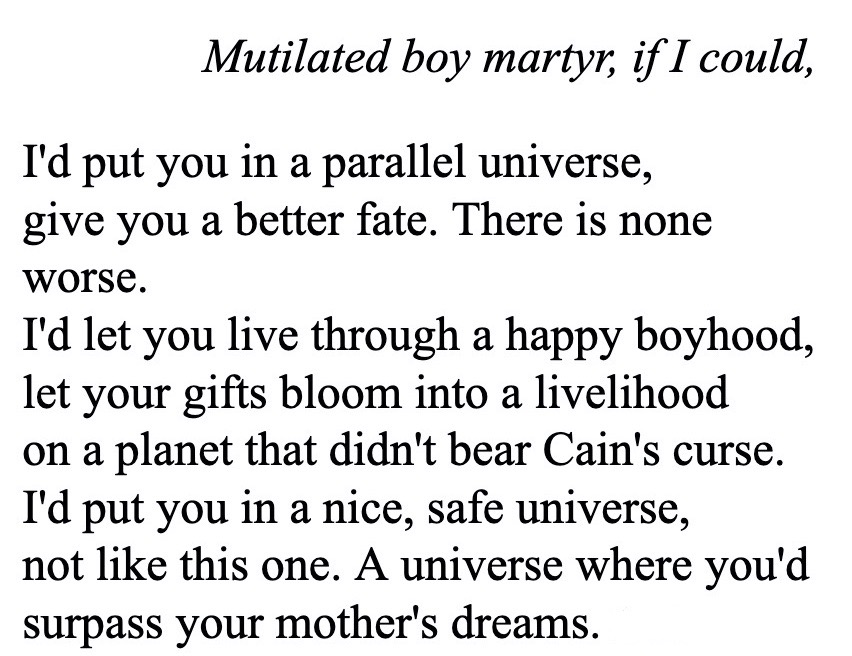
I happened upon the poetic prose of Marilyn Nelson completely by accident this morning on my local digital library site. I was quickly intrigued by her beautifully expressed story of Emmett Till. For those unaware, Emmett Till was a 14 year old black boy who was lynched and murdered in 1955 for whistling at a white woman. His killers were never brought to justice. His mother, Mamie, who lost her husband 10 years before in a controversial hanging, courageously displayed her young son’s mutilated body in an open casket at his funeral. If the law would not prosecute those responsible, she would do it in her own way.

In this sonnet, A Wreath for Emmett Till, award-winning poet Marilyn Nelson speaks for the young man who could not speak for himself and for his brave mother, thrust into the spotlight after his killing. Everything is said with sorrow, with love, and with heart-felt apology. I can hardly do it justice:

Screen Shot 2020-06-10 at 9.32.58 AM

Nelson’s style lends a power that makes mere storytelling inadequate. While probably targeted for young readers, teens and adults will also appreciate this quiet treasure. And, although a quick read, the message lingers long after that we, as humans, still have a long way to go.

9.5 Stars


Children, Fiction, Series & Collections, Young Adult

Daddy-Long-Legs, by Jean Webster

81qjcQXpF1L

I suppose that in today’s world, a story where a rich, older man anonymously sponsors an orphaned girl’s schooling while also orchestrating in-person meetings would seem, well, creepy. And if you watch the movie with Fred Astaire as Jervis Pendleton and Leslie Caron as little Judy there is a great age gap–about 30 years– between them, cute as the movie may be. But, as expected, the book is different.

First of all, it is all set in America, not France. Second of all, in the book it is easier to imagine about a 10-15 year age gap between them. This is more acceptable. The film immediately reveals that Daddy-Long-Legs and Jervis Pendleton are one and the same. The book does not, but it’s fairly obvious to the perceptive reader. It’s a spoiler that does not really spoil, although one does wonder how this man who is so sweet to young Judy in person can let her toil and wonder why her sponsor never writes back, allowing her to wallow in confusion for 3 years. That is a bit more unacceptable.

It’s an odd story, one that could only be told at a time when the role of women was to be demure and subservient. The book is comprised entirely of Judy’s letters to her sponsor, always a risky tactic, but here it seems to work. The letters are detailed enough to help the reader forget that they are only reading letters. We see a range of emotions from the young orphan, plus cute little sketches, and even some back-pedaling as she feels one thing one day (usually frustration with the one-sided relationship) and retracts it with regret the next.

The part I find most perplexing is the reader demographic for this story, which I can only assume is a teenage girl, an age peer of Judy’s, at the time it was written in 1912. Again, a very different time for women, still eight years away from the 19th Amendment. At one point Judy asks “are women even citizens?” (Jean Webster, the author, was a great supporter of women’s suffrage.)

So, if you keep in mind the context of the time period this book was published, it is easier not to judge it too harshly and see it as just a sweet, unusual story.

8/10 Stars

Aside from the full-length 1955 American movie, there are many Japanese anime versions of Daddy-Long-Legs. You can find them on YouTube. I came across this short, 12-min bedtime story version, which actually helped me enjoy the book more. Available HERE on Amazon Prime.

Fantasy, Fiction, Young Adult

Snape, A Definitive Reading, by Lorrie Kim

snape cover.jpg

Definitive, yes. Interesting, no.

Anyone who has invested time reading and/or watching the entire Harry Potter series knows that there is much more to Severus Snape than meets the eye, and certainly much more than he appears in the very first book. Since the end of the series and as Snape’s true nature and motives have been revealed, the character has become an unlikely hero. It is for this reason that I had such high hopes for this book.

Harry Potter author, J.K. Rowling, has released several books with backstories of everything from Hogwarts teachers to the inception of Quidditch. They’re fascinating. And it makes sense. The backstories are coming from the same imagination that conceptualized the characters in the first place.

Snape, A Definitive Reading is the opposite of fascinating.

I see this book as one more example of someone riding on the coattails of someone else’s talent and success. There is nothing revelatory here, but merely a chronicling of every single time Snape and Harry Potter interacted with each other through the book series. And that, my friends, is A LOT of interacting. It’s as tedious as it sounds.

At the beginning I read carefully, but as time went on and the book maintained its dry format, I found myself skimming more and more. It’s a few hours I’ll never get back and, as a favor, I recommend you not waste your time with this book. You can do better and Snape deserves more.

6/10 Stars

Children, Historical Fiction, Nonfiction, Series & Collections, Young Adult

Farmer Boy, by Laura Ingalls Wilder

Frmer Boy cover.jpg

As a child I was given the entire Little House on the Prairie book series. It was, after all, the late 70’s, and the TV show was a local favorite. I read a few of the books, some of them several times, but Farmer Boy always stayed in my blind spot. In some ways I’m glad it did. I’m a big believer that books come into our lives at the right time when we can fully appreciate them and, apparently, Farmer Boy needed to be appreciated in my late 40’s.

This is a stand-alone book from the rest of the Little House series, one that Laura Ingalls Wilder wrote about one significant year in the life of her beloved husband, Almanzo Wilder. Almanzo has just turned nine years old. He has an older brother and older sisters. Poor Almanzo feels what so many children feel when they’re the youngest, always left behind and never given the responsibilities that the older ones are given.

The book is both entertaining and poignant. The way the siblings handle their freedom when their parents leave them alone for a week is hilarious. But the majority of the book is from Almanzo’s point of view as he observes his father work around the farm and train horses, a particular talent his son greatly admires. And, like the Sarah, Plain and Tall series, the reader sees how children were put to work at a young age, never in an abuse manner, but given chores appropriate for their age. Everyone needed to pitch to keep a farm running and most children of farmers grew up to be farmers themselves.

There is a wonderful documentary on Amazon Prime Video called Almanzo Wilder: Life Before Laura. It was this documentary that prompted me to read the book, despite not being in the age group of its target audience. I recommend both the documentary and the book.

9.5/10 Stars

Children, Series & Collections, Young Adult

Sarah, Plain and Tall Series, by Patricia MacLachlan

Sarah Plain and Tall series covers.jpg

If you’re a fan of Laura Ingalls Wilder’s Little House series, then you will be just as charmed by Sarah, Plain and Tall, Skylark, Caleb’s Story, More Perfect Than the Moon, and Grandfather’s Dance.

And, if you know about President Abraham Lincoln’s early childhood, the premise of these books will sound familiar too: a widowed man with two children marries again, the new wife becomes a beloved member of the family and positively influences them for years to come. (In fact, Lincoln’s sister, stepmother, and stepsister were all named Sarah.)

All five of these books are short, but very enjoyable. I was amazed that they weren’t all one multi-chaptered book. But I reveled in their descriptions of a simpler time when families spent so much time together making their farms a success and just enjoying each other’s company. Children learned the value of work much earlier than today and parents were parents. Less focus was placed on material possessions. The days and months had a rhythm to them that followed the harvests and seasons. Hardships, usually due to inclement weather, were plentiful, and families had to adapt in different ways.

This series is both pleasant and powerful in its capturing of the time period.

9/10 Stars


Fantasy, Fiction, Young Adult

The Girl Who Drank the Moon, by Kelly Barnhill

The Girl Who Drank the Moon cover

After some very demanding months in 2019, I can now return to my beloved book review blog! I’ve read and listened to quite a few books over the last few months, but I narrowed them down to a handful of my favorites to include on this site.

A few weeks ago at a “Favorites” party I won the Young Adult book, The Girl Who Drank the Moon. The fact that it is a Newbery Award winner gave me hope. And, despite its fantasy genre, I decided to give it a try.

I’m glad I did.

Set in a gloomy, dystopian society, The Girl Who Drank the Moon is full of symbolism that spills over into our modern world. A government who swears it is protecting the people, even though they insist that one child must be sacrificed to the forest’s witch every year. Characters include a child who escapes the sacrifice, the aforementioned witch, a dragon, a swamp monster, a madwoman in a tower, and a young apprentice trying to figure out what is true and what is not.

I devoured the book in two days, then loaned it to a friend who is a high school librarian. She loved it too.

Do not be put off by the genre, as I first was, or by its target audience. Younger people may not understand every layer in this the book, and that’s OK. But they will still enjoy it. As an adult, I found the symbolism very powerful, worthy of a college paper.

The Girl Who Drank the Moon is most definitely the best book I’ve read in a quite a while. There are some unexpected surprises, which I found very satisfying. And I’ve done my best not to include any spoilers here so that you can experience them for yourself.

9.5/10 Stars

Fiction, Magical Realism, Young Adult

The Strange and Beautiful Sorrows of Ava Lavender, by Leslye Walton

9200000025021139

Clearly, magical realism needs to be a new category on my site. So let it be done.

The Strange and Beautiful Sorrows of Ava Lavender…I’m still trying to decide my feelings about this book as I write this review. Kirkus Reviews expressed it so well: Lyrical magical realism paints four generations of women with tragic lives until a shocking violation fixes everything. (Although I’m not sure I would agree with the word “fixes.” Maybe “ended everything…” And where a female character is involved, the word “violation” can only mean one thing. A bit graphic for a YA novel, IMHO.)

Kirkus Reviews also mentions what so many others have too, which is that the main character, Ava Lavender–if you could call her the main character–isn’t born until nearly halfway through the story, although she narrates it from the beginning. The first half is all about her ancestry, starting with her great grandparents in France. This would be interesting if it were relevant, something only the reader can decide. I did not find it to be so. The tragic genealogy of Ava’s family did not explain the odd fact that she was born with wings, that her twin, Henry, was most likely autistic, or that their mother can predict certain events from their smell.

Like the unique plot, the writing quality is also up for debate. Poetic? Or tedious? I suppose if the writing were truly moving the plot forward, I would’ve appreciated it more, but when so many of the characters at the beginning have no real bearing on the supposed “main character,” I couldn’t help but question the point of the book’s first half. It was like the author was just warming up for the real story…such as it is.

Strange as it may seem, my favorites were Ava’s best friend, Cardigan, and her brother, Rowe. I loved the way they saw beyond her “deformity” and viewed her as just another girl. I also enjoyed the characters of Gabe and Wilhelmina, both steadfast presences in the lives of Ava’s mother and grandmother.

When I’m longing for the “sidekicks” to reappear, that, to me, indicates something is lacking in the story.

This is labeled as a Young Adult novel, but I wouldn’t recommend it. The plot is pretty “out there” and too much is unresolved at the end. (An ending I’m still trying to correctly interpret.)

7/10 Stars