Children, Nonfiction, Young Adult

The Wild Book, by Margarita Engle

WildBook

It is the early 1900s in Cuba. Fefa (short for Josefa) lives on a tropical farm with her parents and many brothers and sisters. She is somewhere in the middle. She feels it too—being somewhere in the middle. Too young to be the teasing older sister, too old to be the indulged baby. And now she must endure the stigma and frustration of “word blindness”—an outdated term for dyslexia. The local doctor, lacking any sensitivity, has stamped that label on her and she can feel it as strongly as if it was scribbled across her forehead. Giving her reading struggles a name does not make them go away.

Meanwhile, dangers are everywhere. Alligator-like caimans lurk in the tall grasses. Bandits hide behind trees waiting to steal cattle. Kidnappers threaten to steal children at high ransoms. Her parents conceal their worries from the family, but Fefa can read the concern on their faces. Words on a page are challenges, but she isn’t blind to her troubled surroundings. She’s an old soul. A worried old soul.

Her mother gives Fefa a blank book to practice her words, “her wild book.” She carefully writes her observations. The empty pages give her freedom but words do not come easily. She reads them back slowly….syl…la…ble…by…syl…la…ble. The farm manager writes a poem in her book. She looks at him with mistrust, but doesn’t know why. A feeling.

Each sentence is brief. Each thought is powerful.

The Wild Book is beautiful! I found it by accident on our online library site, started it last night, and finished it this morning. It is told in poetic prose through the eyes and ears of Fefa. It yearns to be read out loud to fully display its cadence and vivid imagery. (“Manatees on the beach lounging like chubby mermaids.” What a great sentence!)

Every two pages is a new chapter—a new poem—moving the story forward and exploring the depths of Fefa’s troubled heart. Yet the ending is triumphant. Even better, it is the true story of the author’s grandmother.

This is a book I wish I’d had in my elementary school class library! Younger students will appreciate the rhythm. Older students will recognize its depth. This is a special book that appears deceptively simple, but possesses many layers, just like its young heroine.

Parents, read it to your children. They will have new appreciation for the safety they enjoy.

10/10 Stars
Children, Nonfiction, Young Adult

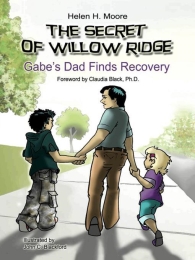
The Secret of Willow Ridge, by Helen H. Moore

2370007452279

If you Google The Secret of Willow Ridge, you will find it available as a free PDF file. The reason for this is because it’s not a children’s mystery book, as the title implies, but a book for children of addicts. The teacher in me was intrigued and I was curious to read it.

Addiction is an isolating disease, both for the spouse and children of the addict. That isolation is the “secret” of Willow Ridge.

Gabe is our eyes and ears in the story. His dad, Jack, is the addict. Jack’s addiction is all Gabe has known in his short life. For him, the word “addict” doesn’t exist until it is explained. In the meantime, his dad’s mood swings, inability to keep a job, and talent for putting new dents in the family car are only a source of embarrassment.

Like any child, Gabe wants two things: a family that functions like the other families he observes and acceptance from his peers. His dad’s addiction has prevented this for years. While Gabe might seem a bit critical in his judgements about his parents, especially his dad, it’s clearly a defense mechanism. This is a child in pain.

Fortunately, the trip to the recovery center happens very early in the story.

The great thing The Secret of Willow Ridge does for young readers who suffer in families such as Gabe’s is it gives them hope–hope that things can change for the better. It also helps to explain addiction in a way a child understands and remove the stigma attached.

This is probably not a book I would put on my classroom shelf, but it is a book I would recommend. If I had a student like Gabe, it could be helpful. Addiction and recovery are covered well, but not glossed over as something easily overcome. As victims of addiction get younger and younger, a book like The Secret of Willow Ridge is necessary.

9/10 Stars

History, Nonfiction

Life Below Stairs, by Alison Maloney

12338204

Even though it has been two years since it’s been off the air, I’ve been mourning the completion of Downton Abbey lately and will probably re-watch my DVDs soon. In the meantime, Life Below Stairs: True Lives of Edwardian Servants has been a fun, quick, informative read.

The whole idea of an upstairs/downstairs lifestyle is very foreign and outdated, but still fascinating. Until reading this book, it never occurred to me how the lack of modern appliances necessitated large amounts of servants in houses that were almost kingdoms unto themselves. However, just like when reading about famous frontiersmen and women, I was reminded that everything took longer in a time when there was no electricity, no washing machines, dishwashers, and often–no indoor plumbing.

I have new appreciation for shows such as Downton Abbey because of the nuances in servants’ characters: the obvious hierarchy among those below stairs, the fierce protection of their jobs, the back-biting and work politics , the sleeplessness, the importance of character references, and the huge amount of rules and restrictions.

And yet, for many, it was either a tireless life in service or abject poverty.

For a poor and unskilled person, but one with great personal potential and a high work ethic, going into service was a terrific opportunity. And, unlike today’s minimum wage jobs, service provided room and board and sometimes, a chance for advancement.

It makes one stop and think how many people today would leap at such a chance, despite the hardships.

This book reads almost like a interesting text book. It is very well organized and uses great “word economy.” There is no fluff, just an outline of the way things used to be in a time now gone. If this is a period in history that interests you, I recommend it.

9.5/10 Stars

Nonfiction

Stiff: The Curious Lives of Human Cadavers, by Mary Roach

Stiff COVER

I always thought I had a fairly strong stomach when it came to the medical field, until I read this book. I also did it an injustice by listening to the audio version of When Breath Becomes Air, a philosophical approach to death that is so beautifully written, any other book I was reading at the time could only pale in comparison.

The smart thing to do is review Stiff: The Curious Lives of Human Cadavers, on its own merits, of which there are plenty.

There is no doubt that the journey of a human cadaver is fascinating. This book talks about all of the different possible routes a body donated to science can take, with a lot of details about those routes. We all know that medical students work on cadavers, but did you know that working physicians do too? They are used to practice procedures before doing them on a live person.  But cadavers are also used for studies on decomposition in different environments–that was a fun, grisly chapter–and as crash test dummies in cars.

You learn about when cadavers were first used, the ethical ramifications, and alternatives where cadavers aren’t even necessary to hone a doctor’s skills. You will also learn about the embalming process and its history. (That was pretty interesting.)

Some things about donating your body to science: It doesn’t go to waste, it will be treated as a gift, and it benefits the future. If you don’t think about where it is going and what might happen to it, you’ll be fine.

All in all, the book is intriguing. There’s plenty to learn and much humor infused throughout without being disrespectful. Who knows? It might even make you rethink your future wishes…when that melancholy event occurs.

8.5/10 Stars


Memoir, Nonfiction, Philosophy

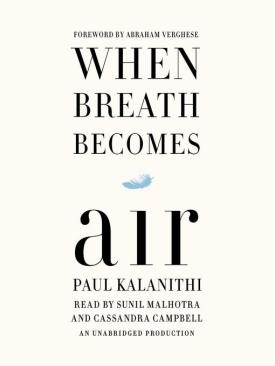
When Breath Becomes Air, by Paul Kalanithi

When Breath COVER

I’m going to do something I’ve never done on this site, which is to reveal my rating for a book at the beginning of its review. When Breath Becomes Air has earned a solid 10, pure and simple. We’ll work backwards from there.

Let me also say that nothing keeps me away from reading a book or seeing a movie more than “hype” surrounding it. The little cynic in me says, “OK, prove it.” So often the material does not live up to the hype, and who wants that disappointment? There has been a lot of that with this book. Ergo my cautious avoidance and wary delayed approach.

When it became available as an audio book on the local online library site, I downloaded it, but with the condition that it was competing with two other books already on my iPhone. “We’ll see how good it is,” I thought.

A few days ago, with the audio version accompanying me on a 130 mile drive, my opinion changed completely. Suddenly, I was glued to the journey of Dr. Kalanithi, an accomplished neurosurgeon in California who was about to start his surgical residency and, almost simultaneously, was diagnosed with aggressive lung cancer.

Lung cancer for a non-smoker seems especially cruel, even more so for someone with such a promising future ahead. The second son of a family of doctors, Paul had received two Bachelor’s Degrees from Stanford, a Master’s from Cambridge, and his MD from Yale. His work was highly regarded and his medical papers were winning awards.  What of this spectacularly unfair turn of events?

One of the words Paul uses frequently is “trajectory.” In regards to his career, his marriage, the possibility (or not) of children, his faith (or lack thereof,) and his future, his trajectory would have to be reset. Not just once, but over and over again.

Now, about my rating. I do not give a “10” lightly. Only a handful of books have qualified. Like other “10” books I’ve read, When Breath Becomes Air never lost my attention. But, more importantly, it is exquisitely written. Not a word or sentence out of place, perfect word economy, and every thought expressed is done so with quality and depth. This is no accident. The author himself once considered writing as a full-time profession.

Instead, it is his legacy.

I highly, highly recommend When Breath Becomes Air. It is eye-opening, witty, fascinating, and majestic. You will not be disappointed.

With all my heart– 10/10 Stars!!


Biography, Memoir, Nonfiction

Watch Me, by Anjelica Huston

watchme5

It was through an odd series of steps that I happened upon Anjelica Huston’s memoir, Watch Me. As a chronic “looker upper”–someone who is constantly looking up words, people, historic events–and even more intrigued when they are intertwined, I ended up checking out the audio book through our local online library.

Part of the third generation of a Hollywood dynasty, Huston has lived an extraordinary life. But the elegant, statuesque woman on the book’s cover was not always that way. Once upon a time she was a quiet, self-conscious teenager who had a lonely childhood and shrank in the shadow of her famous father. I saw proof of this while watching her first interview on YouTube. The composure that has become synonymous with Anjelica Huston was nowhere to be seen.

Watch Me is the second of two memoirs, and it picks up just when Anjelica’s life starts getting interesting. Still, it took years for her to carve her own way in the notoriously cutthroat arena of show business. Her last name opened doors, but it didn’t always keep them open, and it created huge expectations that, as a young actress, she couldn’t always fulfill.

As someone who had a fairly “normal” childhood, it was a bit daunting to hear the amount of famous people Huston has known. She has met and known people from the Golden Age of Hollywood to the modern day. Her 17 year relationship with Jack Nicholson is discussed at length, as are other significant personal connections that defined her as a woman and an actress.

By the end, though, I felt she was a friend who had just shared some of her greatest triumphs and saddest losses. She has a delicate femininity despite her strong appearance and she loves adjectives. Her voice trembles with emotion as she reads about her parents’ deaths and her husband’s final illness. You almost feel you’re reliving those moments with her. It’s clear she has no regrets, realizes the blessings and curses that accompany fame, and still holds on to the memory of loved ones with wistful nostalgia .

8.5/10 Stars


Biography, Children, History, Nonfiction, Young Adult

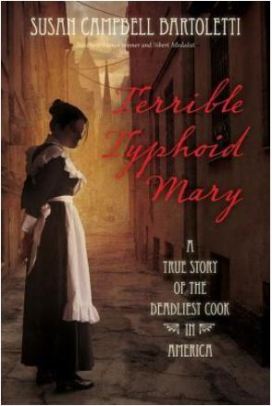
Terrible Typhoid Mary, by Susan Campbell Bartoletti

bartoletti-terrible-typhoid-maryWhen I was an elementary school student in Southern California and discovering for myself which books I enjoyed, I often gravitated towards biographies. Some of my favorites were biographies on Helen Keller, Annie Sullivan, Harry Houdini, and Harriet Tubman. I still remember the covers of each of those books, all of which were worn with use. (In fact, the Helen Keller biography still sits in the bookcase next to me, as do many other childhood favorites.)

I mention this because I know that Terrible Typhoid Mary, by Susan Campbell Bartoletti, would’ve been added to the group. It’s exactly the kind of biography I would’ve read again and again. Not only is it a fascinating true story, but it’s also extremely thorough, and written so well that everyone involved is brought to life. The reader is immersed in colorful descriptions and an interesting cast of characters, who just happen to be real people. (Dr. S. Josephine Baker, one of the first female doctors in the United States, is also prominently featured.) We can just imagine the increasing rage building on Mary Mallon‘s face when Health Department employee, George Soper, finally tracked her down and tried to explain that she was a carrier of Typhoid and was making others ill. We can also imagine the scene where she chased him–and others after him–out of her kitchen with knives and a few choice words.

Mary Mallon’s story is captivating for many reasons and the author covers them all. As the first “healthy carrier” discovered (but not the last,) many important human rights issues are brought to the surface. Did the government have the right to arrest and quarantine Mary when, technically, she had not broken any laws? Did it have the right to insist that Mary give samples of her blood and bodily waste? Were Mary’s stubbornness and violent temper the reasons she was singled out and forced into decades of isolation? Could her situation have been avoided?

The historical period of this real-life drama created other dilemmas. There were hoards of new immigrants flooding into New York City at the time. Sanitation was becoming more of a challenge as population increased. Indoor plumbing, daily baths, and sewers were not yet the norm. The idea that microscopic germs cause disease was also extremely new. (Vaccinations were even newer.) Germ theory was a difficult concept to explain and a source of skepticism among the masses.  And Mary Mallon, a proud, hard-working Irish immigrant who worked her way up the domestic ladder to become a cook for elite families, refused to hear that she wasn’t clean and that she had infected the households who ate her meals. But where do her rights begin and end? Doesn’t the Health Department have a responsibility to stop the spread of disease and prevent an epidemic?

Adults, young adults, and elementary school children will enjoy Terrible Typhoid Mary. It’s the perfect marriage of writer and subject. Teachers and home-school parents will also appreciate the author’s comprehensive bibliography, a terrific example of citing primary and secondary sources that could even be used in a separate lesson. As a biography for school-age readers, this one is as good as it gets.

A well-deserved 10/10 Stars

Nonfiction, Philosophy, Religion, Self-Help

The God Who Weeps, by Terryl and Fiona Givens

9781609071882_p0_v2_s1200x630

As I review The God Who Weeps, by Terryl and Fiona Givens, we must first discuss “audience.”

  • There are those who are members of the Church of Jesus Christ of Latter-day Saints (Mormons) who have great interest in the philosophical workings of their church. They enjoy dissecting, discussing, and analyzing the church to which they belong. They deeply ponder its scriptures, standards, doctrine, and history. By doing this, it only strengthens their testimonies and beliefs. (Many who find great satisfaction in such discussions, including friends of mine, belong to a network called the Mormon Transhumanist Association.)
  • There are other Christians (“other,” because Mormons are also Christians) and non-Christians who are interested in the LDS Church, who perhaps have no desire to become LDS, but are still curious and interested in reading a philosophical approach such as this one.
  • And there are those who make it their life’s work to study religions, either professionally or as a hobby–religions which fall under the umbrella of Christianity, as well as Judaism, Islam, Hinduism, Buddhism, etc., but are mostly interested in comparing and contrasting the various faiths and gleaning, what they perceive, as the best qualities of all of them. “Best,” of course, being subjective to the individual.

While reading The God Who Weeps, I identified people with interests and pursuits, like those above, as the book’s target audience.

Unfortunately, I do not fall in any of those categories. While I am an active member of the Church of Jesus Christ of Latter-day Saints (Mormons,) it is my experience that over-analyzing my faith and Church doctrine also over complicates it and has negative effects on my personal testimony of what I believe to be true. As a result, I usually avoid books such as this one.

That is not saying I don’t recommend The God Who Weeps. There is much good in it. Let’s look simply at the title. The idea of a “God who weeps” is that there is a loving Heavenly Father–an actual FATHER–who cares for us so deeply that our pain is His, our setbacks/worries/challenges/heartbreaks are things He mourns for right along with us.

It is this personalizing of God that I find so attractive and dear about the teachings in the LDS Church. (Among other things.) I feel He knows me individually, hears and answers my prayers, and knows the worries and concerns of my heart.

This Heavenly Father I love so very much is discussed in The God Who Weeps. However, I also feel like the best ideas (those with which I can most identify) are buried under a lot of philosophy and ideas that the authors admit they don’t agree with, but still discuss as a way to promote their original thought: that Mormonism makes sense of life.

So, I have to ask myself, what is the purpose in writing a book like this? To help Mormons feel better about a church they already belong to? To give non-Mormons an analytical perspective?

I would hope that a book like this, at the very least, strengthens the testimony of an LDS Church member. I would also hope that a book like this, at the very least, sparks interest about the LDS Church in someone who is not a member–with the disclaimer that true faith in God the Father and His son, Jesus Christ–as well as discernment about which church is true–may begin by reading a scholarly book like this one, but is actually created and nurtured through sincere scripture study, humble prayer, and a heartfelt witness of the Holy Ghost.

8.5/10 Stars


History, Memoir, Nonfiction, Series & Collections

All Things Bright And Beautiful, by James Herriot

{0EB76228-F8AF-4A23-847A-8EDB7B0E65F6}Img100I love books that I can put down for a while and then pick up again without guilt. James Herriot’s first book in his memoir series as a country vet in England is one such book. Each chapter is like a small short story in itself, chronicling his early years as a new veterinarian in a small farm town.

Because my husband and I have had some very busy months lately, it was nice to have a book at the ready that I could immerse myself in or, if necessary, abandon for weeks on end, without feel like I was leaving a juicy story behind.

Around the years surrounding WWII, James Herriot was new to his profession, sharing an office with his mentor, Sigfried. Sigfried’s younger brother, Tristan, a skilled veterinary student with a wicked sense of humor, also worked there. Having 3 people with different levels of experience approaching the interesting animal cases and eccentric cast of characters in the town make for some pretty interesting stories. Dog, cats, cows, pigs, horses, you will read about them all. Most stories ended happily, but some do not. All add to James’ hands-on education.

Parallel to his adventures in the office and visiting various local farms is James courting his future wife, Helen. The chapter about the large collection of books he buys at a flea market and must, somehow, get home in order to impress Helen is especially hilarious.

There is nothing controversial or offensive in any of his stories. Just interesting, colorful anecdotes of a simpler time when hard work and appreciating the land took precedent over technology and greed.

It isn’t difficult to see why James Herriot’s stories have made a lasting impression on readers for decades. They are truly delightful.

9 out of 10 stars

Memoir, Nonfiction

Led By Example: The Missionary Influence of the Osmond Family, By Deborah Ann Griffin

Screen Shot 2015-04-23 at 2.29.16 PM

After 2 recent “Osmond” themed vacations, it was inevitable that I should read this book. I learned about it from one of the ladies whose story is featured and, at only 78 pages, it was a quick read on the airplane. Agatha Runyon, like many others, was impressed and influenced by this well-know family’s standards in a world that continuously calls such behavior “outdated.”

This is a family who has been in the entertainment industry for over 50 years and still strictly adheres to their religious beliefs. Sometimes they share those beliefs with others, but often it is their example and willingness to “walk the walk, not just talk the talk” that has piqued people’s interest in the Mormon Church.

In this compilation, 15 different people tell their personal stories of conversion to The Church of Jesus Christ of Latter-Day Saints. Because each story is told by a different person, it is impossible to critique the writing except to say that it varies between average and above. The common denominator is that each person was an Osmond fan during the 1960’s and 70’s. It was that pre-internet time when fan magazines were the craze and the only way for teenagers to learn about their pop idols’ personal lives. The Osmonds, to their credit, never hid the fact that they were a church-going family who put the things of God before the things of the world.

Many of the people featured came from homes of dysfunction or with no religious teaching. Besides their musical talent, the Osmonds–a large, loving family with two stalwart parents–attracted teenagers living in less-than-ideal situations.  “Mother Osmond,” in particular, was very generous with her time in reaching out to individuals who had questions about the Church.

Not all of the converts in the book have had personal contact with the family. Many simply admired them from afar and went seeking out missionaries and congregations on their own. The experiences are truly about conversion to the Gospel of Jesus Christ, not conversion to a famous family. The stories are often touching, with several of the people overcoming great obstacles prior to being baptized.

The main message, of course, is that whether we are famous or not, what we do and say gets noticed. If we are consistent, uplifting, and positive, those things can help to change lives.

8.5/10 Stars

Children, History, Memoir, Nonfiction, Young Adult

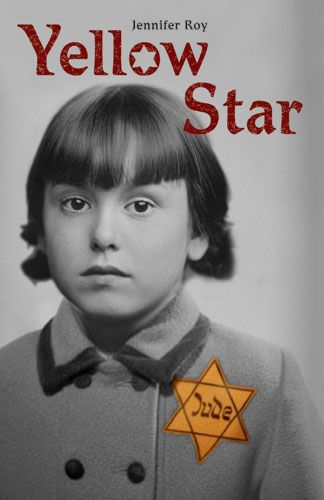
Yellow Star, by Jennifer Roy

v_roy_yellow_star

The Holocaust.

It is one of the most grim events in recent world history. Families are still affected today by lives lost and relatives gone missing.

It is also an event with amazing stories. True stories. Stories that exemplify faith, determination, and strength.

In 2006, author Jennifer Roy endeavored to pen her Aunt Sylvia’s childhood experiences of living in a Polish ghetto during World War II. The “ghetto” was a crowded Jewish internment camp. A neighborhood with barbed wire around it as a way to contain the people Hitler saw as the “problem.” His “final solution” would come later, of course, in the form of concentration camps.

Miraculously, Sylvia (an American modernization of Syvia,) spent the entire war in a ghetto and was one of only 12 surviving children out of thousands. The others became sad, anonymous statistics.

Jennifer Roy is very truthful about her challenges in relating the story. How should she tell it? A narrative? In third person? After trying other methods unsuccessfully, she decides to tell it in Sylvia’s voice, a combination of an old woman’s memories and the simple, but profound, observations of a child.

What emerges are short chapters and efficient language that sound like young Syvia commenting on her changing world. She tries to make sense of things that are senseless.

Why a yellow star? Yellow is supposed to be a happy color.

Bright colors don’t exist in the ghetto, except for the yellow stars and puddles of red blood we carefully step around. “More shootings,” Papa says quietly. His face is gray.

What happened to my friend? She was here yesterday…

Hava is missing. She went for a short walk on the street and never came back. Gone, missing, vanished.

From the ages of 5 to 10, the ghetto, and all that went with it, was Syvia’s world.

It is a child’s honest interpretation of starvation, cold, fear, death, and the unknown. She is acutely aware of her surroundings and the sacrifices her parents make to ease her suffering and keep her safe. “Safe” equals “alive.”

This book would be an excellent teaching tool when discussing the Holocaust, a subject that is quickly disappearing from students’ knowledge of history. Parents should read it with their children. Teachers should read it to their pupils. It is clear in its statement of the times without being overtly frightening. The childhood version of Syvia is relatable and sincere, with that strong sense of fairness that exists in all young people.

Highly, highly recommended.

9.5/10 Stars

Memoir, Nonfiction

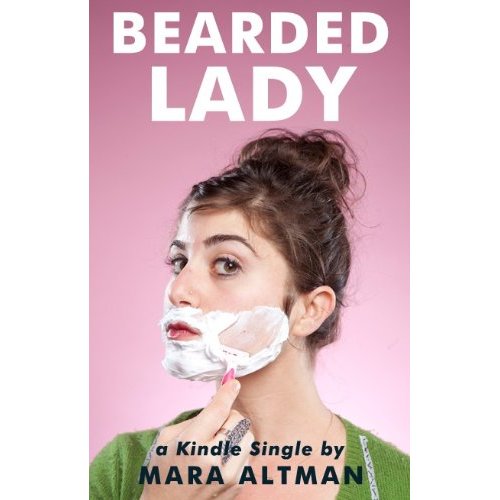
Bearded Lady, by Mara Altman

41nwMDlclmL._SS500_Today, as I left an Amazon browsing session and headed off to a long overdue pedicure, I decided to download a Kindle Single called Bearded Lady.  A Kindle Single is like a short book.  OK, it IS a short book.  This one was 46 pages and my pedi time was almost enough to finish the whole thing.

And the subject, my friends, is Hair.  To be more specific:  Unwanted Hair.

It is basically a short memoir by Altman in an attempt to entertain and to bring together women of the world and their hair removal embarrassment.  As someone who has used Nair, Nads, razors, bleach, wax, and body groomers…I could relate.

There is a certain comfort to read about someone else’s journey into unwanted hair removal, but this is anything but a deep literary experience.  At most, Altman explores the history of when hairless legs and underarms on American women became the norm.  She has quotes from professors of Anthropology and Gender Studies from around the country, none of which are ground-breaking.  The collective thought is that, as hemlines and sleeves got shorter, grooming for women went in a new direction.

Yes, it brought back memories of when my mom handed me my first razor and when my grandma said, “Hija, you have a little mustache.  Try this..” as she handed me my first tube of Nair (which pretty much takes your skin off along with your upper lip hair.) Neither was a memory I needed to revisit.

Overall it was a one-time read, not necessarily one I would recommend, but it was entertaining for the hour it took finish.  My main issue is the use of the F-word a few times, which I LOATHE, and a couple of sh-words peppered in.  Totally uncool and not necessary.

7.5 out of 10 Stars