Memoir, Nonfiction

Gift From the Sea, by Anne Morrow Lindbergh

I’ve said it before…I love being in a book club.  I love being exposed to books that I’ve never heard of before, only to find a book that I have a deep connection with.

Gift from the Sea, by Anne Morrow Lindbergh, is one of those books.

Everything I knew about her was in relation to her husband, Charles Lindbergh.  I knew that he was the first pilot to fly solo across the Atlantic.  I knew that their first child was kidnapped and murdered.

Before getting into the book, let me establish a timeline:

Anne Morrow Lindbergh was born in 1906.  When she was 23, in 1929, she married Charles Lindbergh.  His solo flight across the Atlantic happened 2 years before they were married, in 1927.

In 1932, their first child, Charles A. Lindbergh Jr, who was 20 months old, was kidnapped from their home and the child’s body was found 2 months later. The Lindberghs (who would eventually have 5 additional children) moved to England, then France, and then back to the US in 1938.  After their return, they lived in Maine, Michigan, Connecticut, Switzerland, and Hawaii, constantly seeking a quiet life.

Anne wrote Gift from the Sea in 1955 and won many awards for her writing. Charles died in Hawaii in 1974 at the age of 72 and is buried there.  Anne, incredibly, lived to the age of 94 and just died in 2001 in Vermont.

Why the timeline?  Because when you know about what this woman has endured and experienced, it makes this book all the more amazing.

Gift from the Sea was written while Anne was on a solitary trip to a beach cottage that she had enjoyed as a child.  No husband, no children, no phone, TV or radio.  Just the ebb and flow of the waves outside her door and the shells left behind on the sand.  Each shell a gift from the sea.  And so she began to do what most of would.  She began collecting them.  And so began her journey of introspection.

What follows is a book of such depth and timelessness that, much like the scriptures, you can open it to any random page and find incredible words of wisdom.

Using the shells she finds on the beach, Anne (I call her by her first name because she really feels like a friend) takes her reader through the path of life.  She focuses mostly on women and the many hats they wear as wives and mothers.  She talks about the need for women to define themselves beyond their duties to their families.  She talks about the “dance” of a marital relationship and its desire to evolve over time.  She stresses the need for spouses to enjoy time together away from their children, and even to enjoy time alone away from each other, as a way to fill our cups and find ourselves in order to return to our families and give them someone who is more whole and more at peace.

Considering the time period when she wrote this, I found her ideas to be revolutionary.  A 49 year old housewife in 1955 talking about going on trips by herself is unusual, to say the least.  But as she explores the paradoxes within womanhood, such as our need to give and yet our complaints when we feel that pieces of us are being taken, it make a lot more sense.  She also talks about how we choose certain complications in our lives when we dream of simplicity.  This is so true!

Like all great books, Gift from the Sea gives something different to different readers, which was evident during our book club discussion last night.  The young mother felt like someone understood her frenzied life raising several children.  The newlywed (me) loved the part where she talks about the ever-changing phases in relationships.  The women in their retirement years loved how she looked back on her life with satisfaction and appreciation, despite its trials.  And the interesting thing is that she never mentions her husband, her lost child, or singles out her children, except to mention them as a group “my children.”

I highly recommend this book, especially for women.  Don’t let its age discourage you.  Her ideas are as fresh and as timeless as if it were just written. And even though we do not read it while at a small beach cottage, her writing is so beautiful that you can almost hear the waves outside your window.

9/10 Stars

This slideshow requires JavaScript.

Nonfiction, Self-Help, Young Adult

Eats, Shoots, and Leaves, by Lynne Truss

ImageOh, I so wanted to like this book…

When one of the ladies in our book club suggested it for our May selection I was excited.  After all, as a former teacher I instinctively cringe at the sight of incorrect spelling and bad grammar.  But, alas…

Most of us have heard the joke.  The panda eats shoots and leaves.

Or does the panda eat, shoot, and leave?

This grammatical conundrum is one of many that is explored in Lynne Truss’s book.  Or is it Lynne Truss’ book?

Grammar and punctuation has its place in good writing and, of course, is essential when making one’s point, but is it necessary to devote an entire book to it?  Some say yes, some say no.  After starting the book and reading it thoroughly, I began to think no.  After all, I love chocolate, but I wouldn’t want to read an entire book about it.

I am one of those people who is constantly shaking their heads when I see things like:

“The dog scratched it’s ear.”  (It should be ITS.)

Or “Someone piled all of the jacket’s into a corner.”  (It should be JACKETS.)

This newly adopted problem people seem to be having with sticking unnecessary apostrophes into regular old plural nouns makes me think it is a comment on the whole of society.  BUT, I don’t find it entertaining to read about.  I don’t want to read about the history of the apostrophe and the evolution of its use down through history.  I’m sorry, I just don’t.

Having said that, the children’s version of this book is pretty entertaining because of its simplicity.  There are pictures to illustrate the meanings created by creatively-placed commas and a teacher might find this book very useful in the classroom.  If I had heard of it while I was still teaching, I probably would’ve used it too.  And the lady that suggested it, who is a school librarian, used the children’s book during our book club meeting.

I wish that was the one we read.  The adult version just gets old very fast.

6/10 Stars

Memoir, Nonfiction, Travel

The Kindness of Strangers: Penniless Across America, by Mike McIntyre

Our comfort zones is exactly that…the zone in which we are comfortable.  We rarely travel outside of it.  Is it because of fear?  Anxiety?  Lack of ambition?  Boredom?

In The Kindness of Strangers: Penniless Across America, journalist Mike McIntyre takes the leap and decides to abandon every comfort he knows.  He says goodbye to his job, his girlfriend, his San Francisco apartment, and even his money, in order to conduct a social experiment.  His plan is to hitchhike across the United States–San Francisco, CA to Cape Fear, NC.

The experiment is as much a challenge for himself as for the unsuspecting people he encounters.  As someone who has let fear guide a lot of his decisions in life, he feels like this is his last chance to prove to himself that he has courage.  For Mike, the comfort zone has become a trap.

He has some rules for his trip:  he will accept food, he will accept shelter, he will stay near smaller towns, he will accept rides from 1 man, 1 woman, a man and a woman, a family, but not from 2 men.  He will not accept money throughout the trip.  Not one penny.  He won’t accept it and he won’t carry it with him.  When and if he reaches his destination, he’ll call his girlfriend (collect) and have her mail his ATM card to the nearest post office.

And so he begins…

Food becomes an immediate issue, but less of an issue over time.  Rides vary depending on where he is traveling.

It is the array of people he meets that really make the story, as well as the growth and trust that Mike develops.  In the end, he realizes that the people who have the least, are the most generous.  Makes sense, really, as they understand the plight of someone in need.

There were times, at the beginning, where I found myself rolling my eyes a few times at the description of the people who offered rides.  As someone who is not very comfortable leaving her comfort zone, I was a bit skeptical at the colorful lives and language of so many of the people Mike encountered.  (I’m still a bit cynical after reading James Frey’s A Million Little Pieces, which turned out to be almost completely fabricated.)

But I decided to give the author the benefit of the doubt.  After all, I recently moved from a big metropolis to a small town, and the people are certainly different.  Not better, not worse, but different.

After a while, though, I must admit that some of the people Mike met started to run together.  I focused, instead, on his own growth, of which there was much.  I was also riveted by an experience he had at the end of the book, talking with a man who panhandles for a living.  Apparently there is a lot of that, which is unfortunate for people who are really down-and-out.

As expected, Mike returns home a changed man, but not necessarily how he expected.  The journey affects the way he sees everything, and makes him re-evaluate what is really important.

This is an unusual book about a man who fights his fears and take a journey most of us would never have the courage to do.  It is worth reading.  If nothing else, it restores your faith in the American people.

8.5/10  Stars

Nonfiction, Sports

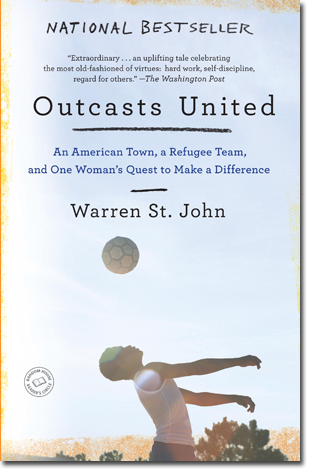
Outcasts United, by Warren St. John

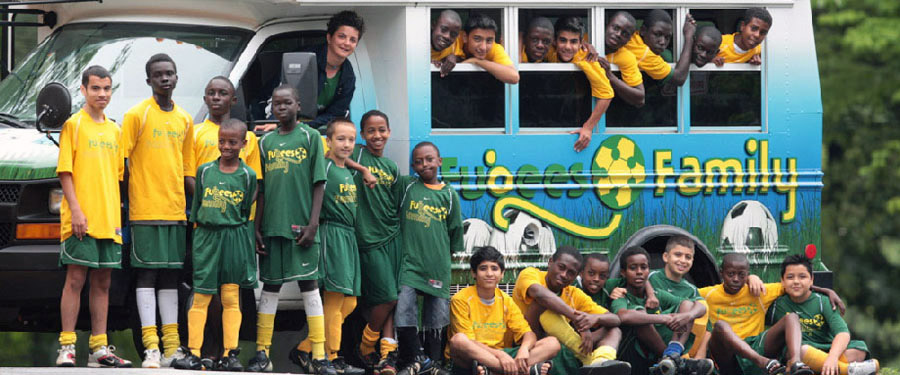
Anytime you read a sports biography, you hope to be inspired and you expect to read about obstacles being overcome.  These were the feelings I had as I began to read Outcasts United, the true story of a Jordanian woman named Luma Mufleh, who moved to the United States and, through a series of events, put together a soccer team full of immigrant, at-risk boys from war-torn countries.

As someone who taught at-risk kids for years, many of them immigrants or children of first generation immigrants, I have a lot of respect for someone who can devote so much time helping these kids assimilate to American culture.  The boys in this story were dealing with all sorts of issues, including the psychological trauma of living for years under the umbrella of war.  Many had experienced the loss of a parent or sibling, lived in ramshackle refugee camps with their accompanying starvation and poverty, and little or no schooling.

The US government, in an attempt to give these families a fresh start in the “land of promise and opportunity,” chose the small city of Clarkston, Georgia, to relocate them.  The housing was sparse and in a bad part of town.  And the city’s residents, many of whom had lived there all their lives, did not take to their new neighbors well.  The differences could not be ignored, and many complained or simply moved away.

Meanwhile, a young woman named Luma Mufleh, was dealing with the challenges of going beyond her own culturally acceptable boundaries and the affect it was having on her family, particularly her father.  She was a Middle Eastern woman who did not want to be put into a certain mold. She was searching for her niche at the same time as the Clarkston refugees were in need of sympathetic leadership.

The story, itself, is inspiring.  I grew to really like Luma.  Her courage and tenacity is to be admired.  She became much more than a coach, but also a tutor, a mentor, and a surrogate parent for many.  She had, and has, very high standards for the boys, insisting that they sign a contract and follow certain rules in order to be on the team.  Hard work, dedication, discipline, and respect for rules takes precedent over athletic skill.

Although the story is inspiring, however, I found the writing to be lacking.  There is a monotone quality to the author’s style that detracted from the book’s potential.  Even though you know that it is a true story, the people in it are still treated in a flat, 2 dimensional way .  It wasn’t until I went to the teams’ website and watched their coach being interviewed that I got a full sense of the kinds of kids she was helping.  She’s energetic and spunky, the kids are excited and hopeful.  This should have been conveyed on the page and, sadly, it wasn’t.

7/10 Stars

Children, History, Nonfiction, Series & Collections, Young Adult

Value Tales Series, by Spencer and Ann Donegan Johnson

One of the many problems with today’s society is that children do not have adequate heroes and role models.  When little girls want to grow up and be Britney Spears and boys want to be Eminem, there is a real problem.  And, part of the reason the kids look to those people is because they are who they see all the time in the media.  So, one way to combat this is by introducing positive role models to them.  And it should be done early, while they are still impressionable and learning about the world.

When I was a kid in the 1970’s, the media’s influences were slightly more controlled because there was no internet, no cable, to texting, heck, no computers.  A friend of my mom’s gave my brother and me a book called The Value of Patience, the Story of The Wright Brothers.  The story was full of facts about these 2 brothers who invented the first working aircraft, and the pictures were bright and colorful and the writing engaging.  We loved that book.

Soon, we started to collect the Value Tales, by Spencer and Ann Donegan Johnson.  The Wright Brothers’ biography was soon followed by The Value of Determination, The Story of Helen Keller and then it was Beethoven, Jackie Robinson, Columbus, Will Rogers, Johnny Appleseed, the list goes on and on.  By the time I was in high school, I had learned about all sorts of historical figures that never seem to make their way into the history books anymore.  Significant people who have made incredible contributions to the world…Ralph Bunche, Nelly Bly, Elizabeth Fry, Cochise, the Mayo Brothers…how many kids today have heard of these people?  Probably very few.  But all of them have books devoted to them in the Value Tales series.  And they are interesting, fun, colorful and educational.  After all, isn’t the best kind of learning when you don’t even realize it?

When I became a teacher, the Value Tales worked their way into my classroom.  My students loved them.  It didn’t matter that each book is about 60 pages.  I had 2nd graders that would sit through an entire volume, hanging on every word, and part of the reason is because the writing by the Johnsons humanizes the subjects.  We learn where they came from, their families, and their struggles and perseverance to obtain success.  And to make things extra fun, a lot of the subjects have little imaginary friends that pop out somewhere in the beginning and become their inner voice.

There are many biographical series available, but you would be hard-pressed to find one that is better than the Value Tales series.  There are around 40 books.  (I have 29.) They are not in print anymore but you can easily find them on Amazon or other used books sites.  Some are very valuable, like the Lucille Ball Value Tale…probably the most in-demand of the series (I still don’t have that one,) which can run $100 just for 1 volume, but most are much, much less.  If you can find a set for sale somewhere that has 10-15 books for around $100, it is a good buy and well worth the investment for your children.

Isn’t it time you gave your kids some good role models?  You’ll find them in The Value Tales.  My childhood set is in my bookcase about 3 feet from me right now. *wink*

10/10 Stars

Entertainment, Memoir, Nonfiction

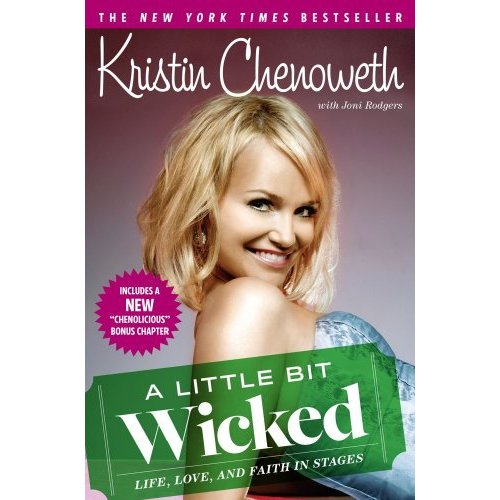
A Little Bit Wicked, by Kristin Chenoweth

Anyone who is a fan of Broadway musicals, and a fan of Wicked–one of the best musicals ever– has heard of Kristin Chenoweth.  Like Judy Garland, there is a whole lotta talent and a whole lotta voice in her tiny 4’11” frame.   So when Borders bookstores were closing down and selling everything at great discounts, I couldn’t resist picking up A Little Bit Wicked.

Like most entertainment memoirs, this is pretty light reading.  But it is fun to read about her beginnings as an adopted child in the Midwest discovering her love of performing and the way she worked her way to becoming one of the Great White Way’s most recognizable stars.  She is also one of the few who has made a smooth transition back and forth between the stage and TV, although her TV characters are usually “larger than life,” as a stage actor is expected to be.  Flashback to her role on the short-lived Pushing Daisies and her many guest appearances on Glee.  Those are some pretty wacky characters.

While I do admire the talent and tenacity it takes to start from the bottom and make your way to becoming a Tony award-winning Broadway star, I do have an issue with one thing.  Kristin calls herself very religious, yet, at the same time, seems pretty promiscuous.  Maybe it was not her intent to give that impression while writing the book, but give it she did.  Perhaps that is her way of justifying the book’s title, but I just found her beliefs and her actions in life a bit conflicting.  Perhaps it was just a little too soon for her to write a memoir.  I felt, by reading the book, that this is a very talented small-town girl who still needs to decide who she wants to be.

Overall, it is a fun book that needs not be read more than once.

7/10 Stars

Entertainment, Memoir, Nonfiction

Forever Liesel, by Charmian Carr

If you asked my mother which songs I sang the most as a child, she would tell you Top of the World, by the Carpenters, and Doe-A-Deer, from The Sound of Music.  In fact, several years ago when we had the thrilling opportunity to meet Julie Andrews at a book signing in Pasadena, that is one of the first things she told her.

I was embarrassed at the time, but quickly got over it, because I’m one of the millions of people around the world who simply adores The Sound of Music.  One of the really nice things is learning about what decent, upstanding people the young cast has grown into.  Forever Liesel, written by Charmian Carr, is a delightful account of what it was like to be a part of this beloved movie.  In a succinct but entertaining way, she talks about learning when she got the part, meeting the rest of the cast, and working with Julie Andrews and Christopher Plummer (on whom she had quite a crush.)  Unlike the rest of the “children,” she was of age where she could work longer hours, enjoy the Austrian location with less restrictions, and associate with the 2 stars off the set.

Unlike so many other young stars who shun the very vehicle that shot them to fame, all 7 of the film’s young actors still appreciate the positive impact that The Sound of Music had on their lives.  They spent years promoting it and making appearances without pay, enjoy having cast reunions, and regard each other with warm affection as much as if they were really brothers and sisters.  And, although most have left acting for other endeavors, they still have fond memories of their months working on the project.

Forever Liesel is not especially earth-shattering, but simply a fun behind-the-scenes look at the making of an iconic film.  It is a fast read that will make you want to cuddle up in front of the movie once again and enjoy it with new appreciation.

8/10 Stars

History, Memoir, Nonfiction

Unbroken, by Laura Hillenbrand

This will be a tough act to follow, but I’m going to start this blog by including my review of Unbroken, by Laura Hillenbrand.  This is a review I actually put on my personal blog, but I can’t think of a better way to christen this site than by talking about this incredible book.  The following is my review from December 4, 2011:

Of all the books I’ve read this year–some for my book club and some for pure enjoyment–the best of the bunch is Unbroken, by Laura Hillenbrand. As I told my mom while describing this book, “Whatever you’re reading right now, this is better.”

Laura Hillenbrand, who is also the author of Seabiscuit, suffers from a debilitating form of CFS (Chronic Fatigue Syndrome,) which forces her to stay at home most of the time. She’s devoted the last 7 years to researching Unbroken, including conducting about 50 interviews with its subject, Louis Zamperini.

Louis Zamperini, who, at the time the book was written, was a spry 94 year old, has lived a life few of us can imagine–partly of his own doing, like competing in the 1936 Olympics– and partly as a victim of circumstance. The circumstances that were not of his choosing happened while he was a bombadier during WWII. The plane he was in was shot down, and the 3 survivors drifted for 47 days until being picked up by the Japanese.

What followed then was 2 years in 2 different POW camps in conditions beyond our imagination. What made the conditions even worse was a particularly sadistic guard, nicknamed “The Bird,” who singled Louis out and attempted to victimize him in every way possible. The army’s pursuit of this guard after the war ended is another element that makes this book so captivating.

I say “attempted,” because one of the interesting things that the book focuses on is the issue of dignity vs humiliation. The authoress describes the importance of dignity in ways I’ve never read before, making it a thing as tangible and necessary to existence as food or air. In other words, no matter how bad the conditions are, you are only a victim if you allow yourself to be.

Even if you know the basics of the story, there is something else that makes it worth reading, and that is the series of odd coincidences that seemed to pop up here and there throughout Louis’s life, and usually during his darkest moments. I don’t want to give too much away, but these oddities certainly make the story even more compelling.

For those with weak stomachs who may be worried about the book’s portrayal of war violence, I would say this: It is “realistic,” but not “gratuitous.” In other words, the authoress tells things as they happened, but doesn’t overdo it.

The important thing to remember about this book is that not only is this a story of “Survival,” but also of “Resilience and Redemption,” just as the tagline reads. Louis’s POW experience is definitely the grittiest part of the book, but there is so much more than that….there’s his adventurous childhood as the town rascal and thief, his foray into becoming a world-class runner, his family, his post-war trauma, and the experiences that finally brought him peace.

This is a book about a man who has experienced the full circle of life and has lived to tell about it. Laura Hillenbrand writes with such amazing quality, you feel like you’re seeing everything as it is happening.

I won’t say anymore about it, except to implore you, again, to read it.  This book and its subject are treasures.

10/10 Stars