Fantasy, Fiction, Young Adult

The Astonishing Color of After, by Emily X.R. Pan

35604686.jpg

Back from a 3 week vacation through Utah, so I’m trying to catch up. I’ll be pasting in my Goodreads reviews on a few books I read while we were away. 🙂

Suicide, depression, grief. These are heavy subjects. Leigh Chen Sanders is trying to cope with all of them. Her mother is gone, depression has clouded their family for years, and now she and her father are trying to pick up the pieces.

And her mother? Her mother is now a bird. A red, fleeting bird who is always just beyond her grasp. Leigh is convinced of it. She is also convinced that the answers she seeks are in Taiwan with the grandparents she’s never met. Her father agrees to take her there.

The rest is a journey of memories and family revelations.

The Astonishing Color of After was my first foray into magical realism. I love the title and the concept of Leigh mentally transferring her mother’s spirit into a bird. But the story fell flat. Leigh is the crankiest, most unlikable character. She is rude to everyone, offended by everything, and acts as if her grief gives her a free pass to treat people horribly. She is at constant odds with her father, who is clearly just trying to keep the family afloat in these challenging circumstances. Yet Leigh never sees beyond her own needs.

The color imagery felt forced. Leigh is an artist and she thinks and feels in colors. But having a character like Leigh create beauty and meaning while being constantly sour does not work. I didn’t care for her, so I couldn’t care about her. Her supposed self-discovery is as ridiculous as her sudden lightheartedness at the story’s conclusion. Everything is tied up in a neat little bow….after all that? My head was spinning.

The reviews I read on the book were overwhelmingly positive, so I dove in with high expectations. Overall I found it to be tedious, very boring, and frustrating. I felt disconnected throughout the entire story and deeply disappointed in the unrealistic ending.

7.5/10 Stars

(My Goodreads Review)

Fiction, Young Adult

The Secret Sense of Wildflower, by Susan Gabriel

15349533

A wonderful, heartbreaking story full of depth, tears and redemption. It took just 3 hours to read.

Wildflower is Louisa May McAllister. Yes, Little Women is her mother’s favorite book and yes, she has sisters named Meg, Jo, Beth, and Amy. That is part of the book’s whimsy. Most of its charm is captured in the 1940’s language of the south, so much so that I found myself reading in my head with a regional accent.

But this is Appalachia and life there is harsh. The McAllisters are mourning the loss of their daddy, dead nearly one year after an accident at the sawmill. Nell, their mama, drifts from day to day, never shedding a tear. Wildflower is part physical orphan through her daddy’s death, but part emotional orphan from her mother. Confidantes are few.

When things are lighter, I felt like I was reading a hybrid of Cold Sassy Tree and Christy. Wildflower reminds me a lot of Will Tweedy in Cold Sassy–observant, with many layers unseen by the surrounding adults. There is, however, a brief but horrible scene that robs Wildflower of her childhood and her innocence. The “secret sense” she prided herself in tried to warn her, but she ignored it. That decision changes everything.

By sheer happenstance, I’ve recently read several books with strong, resourceful female protagonists. The Secret Sense of Wildflower continues this trend. It is, at different times, darling and funny, but also raw and revealing. The language matures alongside Wildflower, becoming more stoic as her reality shifts from child to adult.

I recommend the book, but know what you’re about to read. Teens and adults alike will find it powerfully moving.

9/10 Stars

Fiction, Mystery, Series & Collections, Young Adult

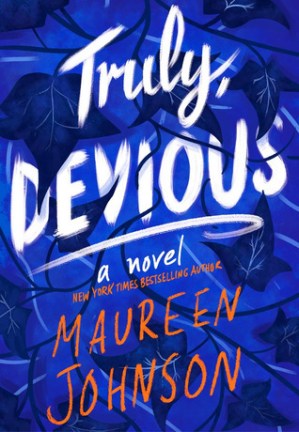
Truly Devious, by Maureen Johnson

truly-devious

What you lack in any investigation is time. With every passing hour, evidence slips away. Crime scenes are compromised by people and the elements. Things are moved, altered, smeared, shifted. Organisms rot. Wind blows dusts and contaminants. Memories change and fade. As you move away from the event, you move away from the solution.  –Truly Devious

This book was recommended by “The Clockwork Reader” Booktube channel. Hannah, the channel’s creator, was so passionate about how good it was that I decided to give it a try. She reads a lot of fiction and comments on a great variety within the genre. That, plus her soothing voice, are making me a return watcher of her channel. Plus, I desperately needed something to balance out my two previous reads.

Advertised as a YA mystery novel, the story in Truly Devious is so slick and the characters so well crafted, that adults would love it too. So, yes, my first Booktube recommendation was a complete success.

Set at Ellingham Academy, a distant cousin to Hogwarts minus the magic, the school is as unique as its students. Built in the 1930’s by newspaper tycoon Albert Ellingham, the school earned unwanted notoriety when the founder’s wife and daughter were kidnapped shortly after its completion. A few years later an overly-curious student is murdered, presumably by the same person, a teasing riddler using the pseudonym of “Truly Devious.”

Fast forward another few decades. The crimes remain unsolved, making them the prime focus and school project of new student, Stevie. She, like all other Ellingham scholars, was chosen as part of an elite program. Plucked from high schools around the country, those admitted are allowed to pursue their own educational paths. Each has a talent, a project, and a goal. The academy’s job is to help them reach those goals.

Stevie is all about solving mysteries, listening to true crime podcasts, and reading the classics by Agatha Christie, Arthur Conan Doyle, and Dorothy L. Sayers. Her instincts are sharp and her perception is honed. The Ellingham crimes are the perfect cold case.

Truly Devious is masterful storytelling. The author, Maureen Johnson, creates an automatic challenge by having so many smart characters, and she meets that challenge with both grace and gusto. The story tick tocks between time periods. There are the days after the initial kidnappings in 1936 and modern day with Stevie and her classmates.   Each time period has a very specific style and it is almost like you’re reading two books at the same time. I also loved some of the poetic rhythms in Stevie’s thoughts and the subtle creativity the author uses in students’ names, especially “Hayes” and “Ellie.” If you read it, you’ll understand.

But be warned, the reader is toyed with almost as much as the characters. The end of the book is not the end of the story. Some questions are answered, some are not, and new ones appear. In any other circumstance that would be maddening. Not here. The next book in the series, The Vanishing Stair, will be released in January and it’s already in my calendar.

9.5/10 Stars


Fiction, Young Adult

Well, That Was Awkward, by Rachel Vail

9780147513984

Cute, witty Cyrano de Bergerac-type tale for the texting generation. Gracie Grant is the main character, with her best friend, Sienna, and best neighbor, Emmett, as her closest confidantes. They’re in 8th grade, experiencing all of the early teen anxiety you would expect. Gracie’s situation is a bit unique because she’s her parents’ surviving child. Bret is the deceased older sister she never knew. Sometimes Gracie talks to her. Sometimes she’s jealous of her. Sometimes she’s mad at her. Ofttimes she feels the weight of her parents’ loss, never wanting to upset them or cause them more pain. As if being in 8th grade wasn’t hard enough.

The writing has that staccato rhythm of teen language. We’re always in Gracie’s head and it’s pretty darn full. Thoughts come in spurts, often expressed immediately after. But, being fourteen also means a lot of self-doubt. A LOT. Every character has it, plus a hundred other insecurities that manifest themselves in different ways–sometimes with regret that requires awkward backpedaling. The author does a decent job of creating individual kids with all of these overlapping qualities.

Texting is the teen language and used frequently in the story. The kids have instant access to each other. (With plusses and minuses to this.) They’re also never alone as long as they have their phones. (Is alone such a bad thing?) And then we have the “texting personality” which is different from the “in person personality.” If the texting personality has, well, MORE personality, then what? You’ve got an already angsty teen with two competing personalities. (Yes, that was on purpose. And if you read that quickly you will get the pace of the book.)

Target audiences will certainly relate to Gracie, her friends, enemies, and frenemies.

Meanwhile, I’ve never been so glad to not be a teenager anymore.

8.5/10 Stars
Children, Nonfiction, Young Adult

The Wild Book, by Margarita Engle

WildBook

It is the early 1900s in Cuba. Fefa (short for Josefa) lives on a tropical farm with her parents and many brothers and sisters. She is somewhere in the middle. She feels it too—being somewhere in the middle. Too young to be the teasing older sister, too old to be the indulged baby. And now she must endure the stigma and frustration of “word blindness”—an outdated term for dyslexia. The local doctor, lacking any sensitivity, has stamped that label on her and she can feel it as strongly as if it was scribbled across her forehead. Giving her reading struggles a name does not make them go away.

Meanwhile, dangers are everywhere. Alligator-like caimans lurk in the tall grasses. Bandits hide behind trees waiting to steal cattle. Kidnappers threaten to steal children at high ransoms. Her parents conceal their worries from the family, but Fefa can read the concern on their faces. Words on a page are challenges, but she isn’t blind to her troubled surroundings. She’s an old soul. A worried old soul.

Her mother gives Fefa a blank book to practice her words, “her wild book.” She carefully writes her observations. The empty pages give her freedom but words do not come easily. She reads them back slowly….syl…la…ble…by…syl…la…ble. The farm manager writes a poem in her book. She looks at him with mistrust, but doesn’t know why. A feeling.

Each sentence is brief. Each thought is powerful.

The Wild Book is beautiful! I found it by accident on our online library site, started it last night, and finished it this morning. It is told in poetic prose through the eyes and ears of Fefa. It yearns to be read out loud to fully display its cadence and vivid imagery. (“Manatees on the beach lounging like chubby mermaids.” What a great sentence!)

Every two pages is a new chapter—a new poem—moving the story forward and exploring the depths of Fefa’s troubled heart. Yet the ending is triumphant. Even better, it is the true story of the author’s grandmother.

This is a book I wish I’d had in my elementary school class library! Younger students will appreciate the rhythm. Older students will recognize its depth. This is a special book that appears deceptively simple, but possesses many layers, just like its young heroine.

Parents, read it to your children. They will have new appreciation for the safety they enjoy.

10/10 Stars

Fiction, Romance, Women's Fiction, Young Adult

Love & Gelato, by Jenna Evans Welch

Love-Gelato

This cute story is the debut of Jenna Evans Welch, daughter of author Richard Paul Evans (The Christmas Box, The Locket, The Walk, and so many others.) When I started the book I thought the reader demographic was women, but I quickly discovered it is Young Adult Fiction. That is FINE. I’ve read enough YA Lit to see the way boundaries are constantly being pushed with sexual themes and coarse language, so it is comforting to know a new author like Welch is providing cleaner options. If I had a teenage daughter, I would have no problem recommending this book. (age 15+ IMHO)

Speaking of teenage daughters, on to the plot, told in first person by 16 year-old Lina Emerson. Lina, originally from Seattle, has just suffered the worst loss of her life, the death of her mother, photographer Hadley Emerson. Now, at her mother’s request, Lina is off to Florence, Italy to stay with her mother’s art school friend, the dependable Howard Mercer, who is superintendent of a World War II cemetery.

All of the adventures in Love & Gelato take place in just under a week, a dizzying pace for anyone over 21, but not so for an emotional teenager. The day after her arrival, Lina meets Ren (short for Lorrrenzo..be sure to roll that “r”) Ferrara. Ren introduces Lina to other ex-pat kids and possible classmates (if she decides to stay,) shows her Florence’s points of interest, and becomes Lina’s confidante on her quest to discover her mother’s connection with the city–and with Howard, who may or may not be Lina’s father.

Like most teenagers, driven more by heart and hormones than their heads, Lina jumps to certain conclusions without all the facts. But what I enjoyed most was the writing, which had plenty of wit as Lina sizes up each new person and situation she encounters.  Her “map” to the city is an old journal belonging to her mother. Those entries I found to be a bit flat and forced–the author is obviously trying to create a separate, distinct voice–but they were not numerous enough to detract from the overall story.

The sequel, Love & Luck, is also available, and centers around Addie, Lina’s American best friend with whom she frequently calls or video-chats for advice and support.

Love & Gelato is sweet and engaging, without being too saccharine or sarcastic, a tough line to walk with YA Lit. It is a quick read (one day for me) and a simple escape. I even found myself Googling some of the tourist spots mentioned, which was helpful. Now I just need to buy some gelato.

8.5/10 Stars

Children, Nonfiction, Young Adult

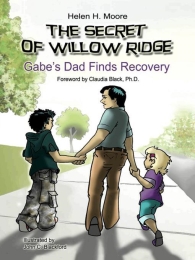
The Secret of Willow Ridge, by Helen H. Moore

2370007452279

If you Google The Secret of Willow Ridge, you will find it available as a free PDF file. The reason for this is because it’s not a children’s mystery book, as the title implies, but a book for children of addicts. The teacher in me was intrigued and I was curious to read it.

Addiction is an isolating disease, both for the spouse and children of the addict. That isolation is the “secret” of Willow Ridge.

Gabe is our eyes and ears in the story. His dad, Jack, is the addict. Jack’s addiction is all Gabe has known in his short life. For him, the word “addict” doesn’t exist until it is explained. In the meantime, his dad’s mood swings, inability to keep a job, and talent for putting new dents in the family car are only a source of embarrassment.

Like any child, Gabe wants two things: a family that functions like the other families he observes and acceptance from his peers. His dad’s addiction has prevented this for years. While Gabe might seem a bit critical in his judgements about his parents, especially his dad, it’s clearly a defense mechanism. This is a child in pain.

Fortunately, the trip to the recovery center happens very early in the story.

The great thing The Secret of Willow Ridge does for young readers who suffer in families such as Gabe’s is it gives them hope–hope that things can change for the better. It also helps to explain addiction in a way a child understands and remove the stigma attached.

This is probably not a book I would put on my classroom shelf, but it is a book I would recommend. If I had a student like Gabe, it could be helpful. Addiction and recovery are covered well, but not glossed over as something easily overcome. As victims of addiction get younger and younger, a book like The Secret of Willow Ridge is necessary.

9/10 Stars

Fiction, Young Adult

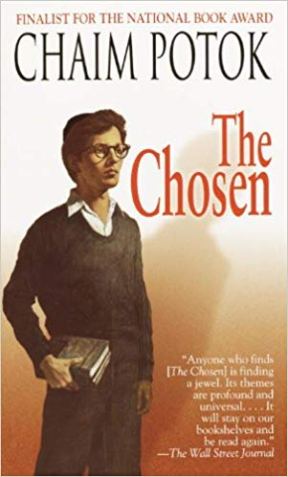
The Chosen, by Chaim Potok

41ZPUySSONL._SX299_BO1,204,203,200_

I always have an extra amount of respect for an author who treats his/her reader as an intelligent being, who does not pound a heavy-handed agenda into the reader’s head, but presents a “buffet” of ideas, if you will, that the reader can choose from and decide which is right or wrong. At the very least, allowing the reader to choose the idea or philosophy with which he/she is most comfortable. (Right or wrong is so often subjective.)

Chaim Potok does this in his brilliant novel, The Chosen. The backdrop is different sects in Judaism at the end of World War II. And, unlike the previous book I reviewed here that was about a mother/daughter relationship, The Chosen looks deeply into father/son relationships. But it does more than that. It puts two teenage boys together in an unlikely way and poses many questions:

  • Who is being raised the right way by his father? (Is there a right way?)
  • Who is “the chosen?” (And…chosen for what?)
  • Are we born with a soul? Or is it something that grows within us by the choices we make?
  • And, when it comes to being devout in religion, how much is too much?

Leaving the reader pondering all of these questions (and more) is, in my opinion, the mark of high-quality writing. Why? Because Life rarely ties things up in a neat little package.

While getting more invested in the story, I started to think of other great books that have two male protagonists who are very different, brought together in odd circumstances and who forge a deep friendship or a bond that is created out of curiosity for one another. After brainstorming, I realized there are many:

  • A Separate Peace, by Jon Knowles (Which takes place during the same time period as The Chosen. It’s been years since I’ve read it, and I’m currently listening to the audio version.)
  • The Great Gatsby, by F. Scott Fitzgerald
  • Bridehead Revisited, by Evelyn Waugh
  • The Kite Runner, by Khaled Hosseini

Strangely, as many books as there are with these types of characters, there is no specific genre name given to them–and there should be–because they are unique types of stories.

The two in The Chosen are Reuven Malter (modern Orthodox) and Danny Saunders (Hasidic,) brought together, ironically, by a baseball game, the all-American sport. If you created a Venn diagram on these two boys it would be fascinating, because they have much in common. Their differences, however, are what drive the story forward, and their respective fathers are the heightened versions of those differences.

Chaim Potok does a marvelous job of bringing both sets of fathers and sons to life. Their influences, emotions, thoughts, victories, and defeats all feel very authentic. Whether for a book club, a class discussion, or individual enlightenment, The Chosen is worth your time.

10/10 Stars

Fiction, Young Adult

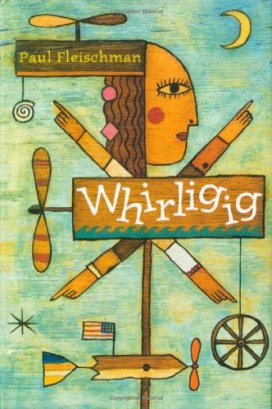
Whirligig, by Paul Fleischman

0805055827

When I came to the end of Whirligig, a book I listened to on Overdrive’s audio app, I was surprised to learn that it was published 20 years ago. Why? Because the protagonist, Brent Bishop, is the poster child for the modern depressed teen. Despite a privileged upbringing, he has no sense of identity, no hobbies or skills, and measures his self-worth against the yardstick of popularity. Life has no real purpose and he is connected to no one and nothing.

It’s a sad way to live, but when you meet Brent’ parents, who drift forward through life in much the same way, the person he is becoming makes more sense. As such, Brent is an unhappy person, but when all of your energy goes towards yourself, it is any wonder?

The themes of the book are connection, redemption, and self-discovery. Unfortunately, it takes a horrible tragedy to put Brent on the path to these things. A life with much promise is snuffed out due to his selfishness and, as restitution, he must take a journey around the country, building and placing four whirligigs in honor of the life he carelessly took. Suddenly he is compelled to create, to interact, to observe, and most importantly, to think of others and how we’re all part of a larger plan.

Yesterday, two-thirds into the book, I read a cynical review on Goodreads from a woman who was appalled at the book’s message, which she interpreted as an “angsty teenage boy” using the death of someone else “as motivation for their own self-discovery.” And, while there may be some truth to this, I see most of Brent’s angst as a result of his upbringing. Little of his parents’ energy has gone into teaching him to care, to love, to show compassion for others, or to do anything really worth-while. Until he’s forced to do something for someone else, he merely exists. It’s a sad commentary on the way so many people live, perpetuating that purposeless state through their children.

The book is far from flawless, but it has heart. Aimed at teenage readers, it’s core message is one you hope they will recognize, learn from, and carry into the future.

8/10 Stars


Biography, Children, History, Nonfiction, Young Adult

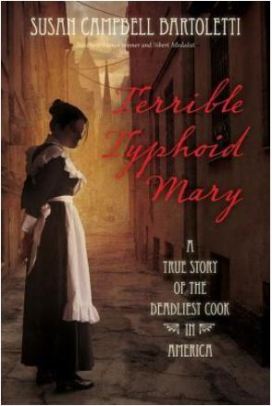
Terrible Typhoid Mary, by Susan Campbell Bartoletti

bartoletti-terrible-typhoid-maryWhen I was an elementary school student in Southern California and discovering for myself which books I enjoyed, I often gravitated towards biographies. Some of my favorites were biographies on Helen Keller, Annie Sullivan, Harry Houdini, and Harriet Tubman. I still remember the covers of each of those books, all of which were worn with use. (In fact, the Helen Keller biography still sits in the bookcase next to me, as do many other childhood favorites.)
I mention this because I know that Terrible Typhoid Mary, by Susan Campbell Bartoletti, would’ve been added to the group. It’s exactly the kind of biography I would’ve read again and again. Not only is it a fascinating true story, but it’s also extremely thorough, and written so well that everyone involved is brought to life. The reader is immersed in colorful descriptions and an interesting cast of characters, who just happen to be real people. (Dr. S. Josephine Baker, one of the first female doctors in the United States, is also prominently featured.) We can just imagine the increasing rage building on Mary Mallon‘s face when Health Department employee, George Soper, finally tracked her down and tried to explain that she was a carrier of Typhoid and was making others ill. We can also imagine the scene where she chased him–and others after him–out of her kitchen with knives and a few choice words.

Mary Mallon’s story is captivating for many reasons and the author covers them all. As the first “healthy carrier” discovered (but not the last,) many important human rights issues are brought to the surface. Did the government have the right to arrest and quarantine Mary when, technically, she had not broken any laws? Did it have the right to insist that Mary give samples of her blood and bodily waste? Were Mary’s stubbornness and violent temper the reasons she was singled out and forced into decades of isolation? Could her situation have been avoided?

The historical period of this real-life drama created other dilemmas. There were hoards of new immigrants flooding into New York City at the time. Sanitation was becoming more of a challenge as population increased. Indoor plumbing, daily baths, and sewers were not yet the norm. The idea that microscopic germs cause disease was also extremely new. (Vaccinations were even newer.) Germ theory was a difficult concept to explain and a source of skepticism among the masses.  And Mary Mallon, a proud, hard-working Irish immigrant who worked her way up the domestic ladder to become a cook for elite families, refused to hear that she wasn’t clean and that she had infected the households who ate her meals. But where do her rights begin and end? Doesn’t the Health Department have a responsibility to stop the spread of disease and prevent an epidemic?

Adults, young adults, and elementary school children will enjoy Terrible Typhoid Mary. It’s the perfect marriage of writer and subject. Teachers and home-school parents will also appreciate the author’s comprehensive bibliography, a terrific example of citing primary and secondary sources that could even be used in a separate lesson. As a biography for school-age readers, this one is as good as it gets.

A well-deserved 10/10 Stars

Fantasy, Fiction, Series & Collections, Young Adult

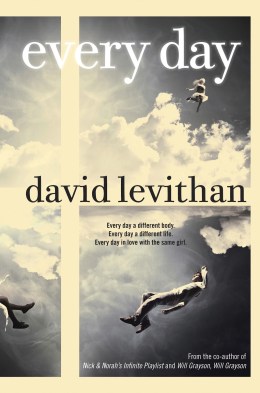
Every Day, by David Levithan

every-day

In 16 years of life, “A,” an entity who is neither male or female, has lived every day in a different body. The name “A” is self given. That, an email address, and a favorite book are the only consistencies A knows. Everything else is a mysterious, Quantum Leap-style existence, with no relationships, no family, no connections.

Enter Rhiannon. On the day A inhabits the body of Justin, Rhiannon’s self-absorbed boyfriend, A connects. The dilemma is clear. How do you maintain a relationship, let alone explain your unique situation, when tomorrow is always uncertain? Uncertainties exist for all of us, but the variety of bodies, lives, families, distances, mental/physical health situations, and transportation options dictate the level of control A has in pursuing this connection.

With no rules and no explanation as to why A is destined to live this way, A has had to create rules. Try not to derail the life of who you are inhabiting too much. Try to be responsible with a body that is not your own. Embrace goodness. If possible, try to leave the person a bit better than when you arrived, even inserting some happy memories once in a while.

Seeing glimpses of so many lives has given A a bit of an advantage in some ways, but has also created some severe deprivations. If there is any positive lesson to be learned from witnessing A’s struggles, it is the importance of stability and loving relationships in a person’s life.

There is no doubt that David Levithan is a creative writer. I was much more absorbed in this story than with Dash & Lily. The author makes some fascinating choices with the bodies A inhabits.  I still think Levithan walks a tightrope in some of his themes and ideas, but I understand that is his prerogative. But as such, it’s my opinion that parents ought to pre-read his books.

As I mentioned in another review, I am not in the author’s target age demographic. I cannot help but look at his YA novels from an adult perspective. And, while Every Day was not peppered throughout with popular profanities (as in Dash & Lily,)  David Levithan’s strong social opinions took their place. It’s clear he has an unapologetic loathing for many things most people would consider traditional.

As far as plot, my main dissatisfaction with Every Day was the ending. It was horrendous because, in order to know what really happens next, the reader is forced to move on to the sequel, Another Day.  I don’t like feeling forced. (Does anyone?)

A half-hearted (and forced) 8/10 stars.


Children, Fiction, Mystery, Young Adult

Wonderstruck, by Brian Selznick

book-cover

We are all in the gutter, but some of us are looking at the stars.

–Oscar Wilde, from Lady Windemere’s Fan

Two of our deepest longings in life, whether we acknowledge them or not, is (1) to be connected to someone or something in a world where it is too easy to feel adrift and (2) to be heard and validated through some means of communication.

Then there is the subject of communication. How do people communicate? Through a specific language, either written or spoken using an alphabet or gestures, like American Sign Language. There’s also Morse Code, Braille, semaphores, hieroglyphics, and many others. Humans have a great need and desire to communicate with one another and have, therefore, created many ways to do so. To be unable to communicate is to be isolated, even in a room full of people.

Enter the two main characters in Brian Selznick’s Wonderstruck, Rose in 1927’s Hoboken, New Jersey, and Ben in 1977’s Gunflint, Michigan. Two twelve year olds in different cities, fifty years apart. How are they connected?

The way Brian Selznick achieves this is like nothing I’ve ever seen. Ben’s story is told through the written word. Rose’s story is told through incredibly impressive and expressive pencil drawings done by the author. The drawings leave no room for misinterpretation.

Despite their differences, both children are on a similar journey with similar challenges. Both are trying desperately to fulfill those longings for connection and communication. The pacing is excellently done using the different modes of storytelling. So excellent, in fact, that the reader is aware of the overlap in the children’s stories as it’s happening (I’m trying to avoid spoilers here.) And, while the story feels like a fantasy, there’s still a sense of it could happen.

There is a lot of potential discussion to be facilitated between teachers and students using Wonderstruck as its source. I think it would work successfully in both a classroom or a home-school setting. Amazon Prime just released the movie version a few days ago, but I believe the movie works better as an addendum to the book. There is a sweetness unique to the book that is lacking in the movie, as well as a layer of truthfulness regarding Ben, because only in the book do we hear his inner dialogue. But I will say the young actress who plays Rose in the movie is mesmerizing to watch.

Overall, I recommend Wonderstruck with confidence. I was even more impressed when I read about the amount of research Brian Selznick employed in its creation. It is an award-winning middle school book, but I think it would be entirely appropriate for younger, emotionally mature children. If a parent or teacher has specific questions before sharing it with school-aged children, please feel free to contact me or leave your question in the comments. I will answer it promptly.

9.5/10 Stars

P.S. A 55-page summary and study guide of Wonderstruck is also available on Amazon, but I have not read it.